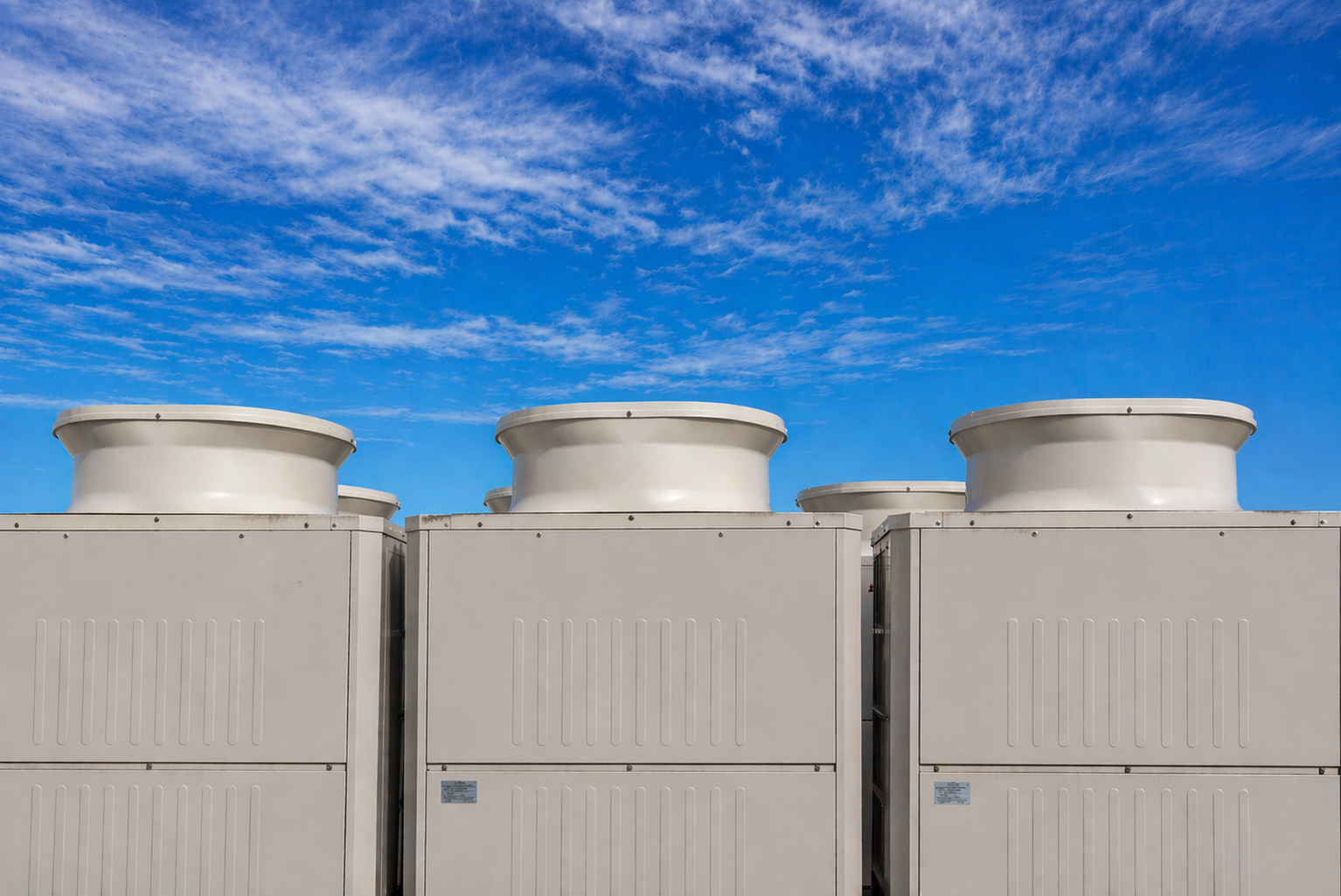
One outdoor unit connects to up to 50 indoor zones, each maintaining its own temperature. Individual control throughout your entire building, without compromise.
Variable refrigerant flow describes a multi-zone arrangement in which a central outdoor unit conditions refrigerant and sends it through compact refrigerant piping to indoor terminals across the building. The abbreviation VRF is the generic engineering term; VRV is a manufacturer's designation for essentially the same operating principle.
Instead of alternating between full blast and idle, inverter-driven compressors modulate capacity while controls steer how much heating or cooling each indoor unit pulls from the circuit. Zones can operate at different temperatures at the same time, so occupants are not tied to one blanket setpoint across an entire facade or floor.
These layouts are common wherever several spaces need dependable climate control: apartments and larger homes, offices, clinics, hospitality, retail, and multi-storey developments. The same fundamental architecture scales from discreet residential footprints to sizeable commercial portfolios, backed by networked outdoor sections when total load grows.
Zoning is the practical payoff: quieter or unoccupied areas can taper demand while active rooms stay on target. Because output tracks load in finer steps rather than repeated on-off cycles, well-designed projects tend to realize meaningful savings over oversized single-stage layouts or fleets of minimally coordinated splits addressing the same area.
Indoor terminals are supplied in cassette, concealed ducted, wall-mounted, floor-standing, and other formats, so ceilings and interiors are not confined to one fixture type. Indoor equipment is routinely specified for subdued sound levels appropriate to bedrooms and meeting rooms—while locating larger noise sources outdoors keeps occupied spaces calmer overall.
See how variable refrigerant flow outperforms standard split systems
The system moves refrigerant from one outdoor unit through a network of pipes to indoor units in different rooms, with controllers managing temperature in each zone independently.
One powerful unit serves your whole building. No need for multiple outdoor units taking up rooftop or ground space.
Available in five styles — ceiling cassette, ducted, wall-mounted, floor-standing, and suspended — to suit any room layout and interior design requirement.
Intelligently routes refrigerant to zones that need it, reducing the total pipe length required and improving system efficiency across the building.
Wall-mounted or wireless controllers let each room set its own temperature, mode, and schedule — giving full comfort control without affecting any other zone in the building.
From a single outdoor unit to dozens of indoor zones, every component works in harmony — monitored and managed from a central building management system for maximum efficiency and control.
Each room deserves the right unit for its size and layout. Ceiling cassettes work best in open areas. Ducted systems vanish into walls. Wall-mounted units suit smaller rooms. Floor-standing models fit corners. Suspended units hang from ceilings. Pick what works for your building.
Square or rectangular units mount flush to the ceiling, distributing air evenly across large open areas without visible ductwork.
Concealed piping and discreet grilles maintain clean sightlines while conditioning entire rooms or multiple zones from a single unit.
Compact and efficient, these units mount at eye level or higher, ideal for offices, bedrooms, and smaller commercial spaces.
Square or rectangular units mount flush to the ceiling without visible ductwork or pipes.
Office buildings
Zone control lets each department manage its own temperature. Energy savings come from cooling only occupied spaces during business hours, reducing utility costs significantly.
Industrial facilities
Industrial facilities with varying cooling demands benefit from VRF's ability to heat some zones while cooling others simultaneously, making it ideal for complex manufacturing environments.
Luxury residences
Quiet, invisible systems that don't compromise design. VRF delivers individual room control without visible indoor units, maintaining the aesthetic integrity of high-end homes.
Open offices
Open offices stay productive when teams control their own comfort zones. VRF reduces energy consumption by conditioning only occupied areas, cutting utility bills while keeping everyone satisfied.
Share your layouts or occupancy needs—we respond with zoning strategies, equipment options, and a clear path from specification to commissioning.